
In 2026, according to Zillow, we are projected to close 4,080,000 existing home sales in the United States. To put this number into context, it will be the lowest number of transactions since the depths of the Great Financial Crisis in 2010 when 3,450,000 existing homes sold.
What makes the 2026 number even more alarming is that the population of the US in 2010 was 308,745,538 and it is estimated to be 343,000,000 today. This means that during the Great Recession, 11.2 homes per thousand people were sold compared to 11.9 now. The population adjusted numbers are very close.
There will be over 33% fewer homes sold in 2026 relative to 2021.
It is not surprising that there are so few transactions, given historically low affordability and the “lock in effect”; 52% of existing mortgages are below 4%, while current rates are 7+%.
What might be surprising to some is that median home PRICES, while soft, have not gone down in a meaningful way. This is because there are very few people who “HAVE TO” sell. In aggregate, existing homeowners are sitting on trillions of equity and a good number have those aforementioned ultra low mortgage rates or no mortgage at all.
The problem with historically low single family real estate transactions is two fold.
Firstly, for people whose incomes rely on those transactions (real estate agents, mortgage brokers, title company employees etc…) it is among the worst times in history to hold those jobs. There just isn’t much pie to go around. It’s really challenging.
Secondly, housing historically represents a significant percentage of US Gross Domestic Product (GDP) which is the ultimate scorecard for the health of the US Economy.
The depressed housing activity poses a threat to GDP and ultimately the overall economy.
Fortunately, so far, the lack of real estate activity has been more than counter balanced by unprecedented corporate spending on AI. AI equipment investment increased 20.9% annually in Q3 of this year. Data center construction and other infrastructure investments grew at over 100%.
AI is exciting and it will change the world. That being said, when the internet first came out it was the same story and it ultimately came to fruition. However it did not come to fruition without massive speculation.
The “dot com bubble” burst in 2000 ultimately resulting in the NASDAQ bottoming out in October of 2002 at 77% below its peak. The crash wiped out trillions of dollars in market value and triggered a broader economic slowdown. The NASDAQ did not get back to its March 2000 peak until April of 2015.
Again, AI will continue to change the world, but is overspeculation at hand? I rarely make such predictions, but it feels very similar to the dot com era.
There does not yet appear to be a proven, scalable and durable business model to match the depth and breadth of AI investment and speculation. (Poor business models built on hype were a dime a dozen during the dot com craze). I will not be surprised when there is a significant AI related market correction over the next 12-24 months.
What Does It All Mean For Buy & Hold Investors
1) The transaction story will not change quickly.
The late 70’s and early 80’s represent a frame of reference. In 1978, there were 3,910,000 existing home sales. Just like in our recent cycle, inflation spiked and so did interest rates. By 1982 transactions plummeted to 1,990,000 (Prices did not go down). It was not until 1994 (16 years from the peak) that transactions got back to at least 3,910,000. While it may not take quite that long, we should expect things to play out similarly.
2) Diligent and persistent deal seekers have less competition and more leverage.
With high interest rates and high prices and the struggling narrative around the housing market, many “want to be” buyers have disengaged. This is at a time when very few sellers are motivated to sell. That being said, those that do put their homes on the market have a much higher likelihood of being very motivated. They are more likely to be in the “HAVE TO” sell bucket. This means buyers have more room to negotiate not just on price, but on terms. Remember, builders are undoubtedly in the “HAVE TO” sell bucket.
3) We are reminded of the power of the acquire and hold model.
Despite the transaction crash, prices not going up and mortgage rates remaining elevated after the massive spike in 2022, we as acquire and hold investors, are unaffected.
We are reminded of the power of the 30 year mortgage. How glad are we, that we did not get 5-10 year ARM’s over the last decade?
We are reminded that the direction of prices is of little consequence to us especially because our 30 year mortgages very rarely put us in a “HAVE TO” sell position. We are more concerned with what happens to rents as we discussed in our article entitled “My Favorite Economic Chart”. Rents have never gone down meaningfully for an extended period of time.
In fact, there is a case to be made that we are on the brink of another wave of rent growth. After a large wave of construction, especially in higher end multifamily (a competitor that muted SFR rent growth), the pipeline of future construction is projected to fall off significantly. See chart below.
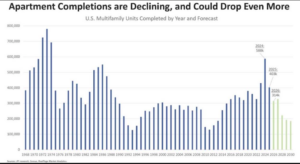
Lower competitive supply, coupled with pent up household formation demand and unaffordable home ownership suggest rents for SFR’s will rise.
If there is an AI related market correction and unemployment results, this could mute rent growth, but for the savvy, cash flow from day one, 30 year fixed rate acquire and hold investor, rent growth, like appreciation, are the tasty cherries on top.
Leave a Reply